

From Content to Knowledge: Why Structured Content Models Are the New Frontier of SEO
The shift from GEO to AEO isn't a tactic. It's an architecture decision your CMS made years ago — and it's costing you visibility right now.
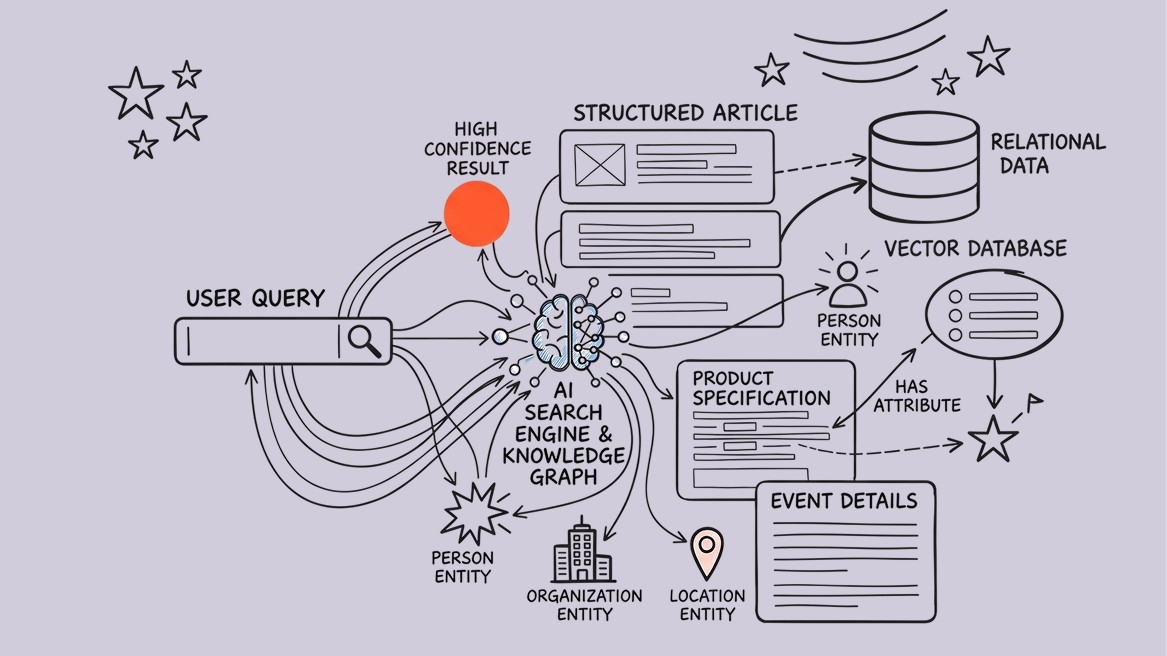
The strategic shift from "string" to "thing"
For two decades, search rewarded the brands that matched keywords most cleverly. That game is over.
Google has quietly transformed itself from a search engine into an answer engine. Gemini, AI Overviews, Perplexity, and ChatGPT no longer hand users a list of blue links — they synthesise an answer. And the brands cited inside those answers aren't necessarily the ones with the best keywords. They're the ones whose content is structured as data, not prose.
This is the move from strings (isolated keywords floating in a page) to things (entities — distinct, defined concepts connected to other concepts). Google's Knowledge Graph, the engine behind this shift, now holds hundreds of billions of facts about billions of entities. It is, functionally, the brain of modern search.
Two new disciplines have emerged from this shift:
- AEO - Answer Engine Optimisation. Optimising for the immediate factual retrieval that powers voice search, featured snippets, and "position zero."
- GEO - Generative Engine Optimisation. Ensuring your brand's perspective, data, and expertise get synthesised into AI-generated answers.
Both depend on the same foundation: content that machines can read as structured knowledge, not as a wall of text.
What "entity-rich" content actually means
Google defines an entity as a thing or concept that is distinct, unique, well-defined, and distinguishable. That's the atomic unit of modern search.
Here's the uncomfortable truth: most enterprise content fails this test. It lives as a "blob" — paragraphs of unstructured text inside a legacy WYSIWYG editor, with no machine-readable relationships between the concepts inside it.
A structured approach looks completely different.
Take a financial services offering. In a legacy CMS, it's a page with a heading, some marketing copy, and a CTA. In a structured content model, that same offering is a dataset containing:
- Interest rates (as numeric attributes, not text)
- Eligibility criteria (linked to customer segments)
- Compliance disclosures (linked to regulatory entities)
- Subject-matter experts (linked to author profiles, credentials, and other content they've authored)
- Related products, case studies, and FAQs (semantically linked, not just hyperlinked)
When AI crawlers ingest this, they don't just see words. They see relationships. They see authority. They see a brand that is a known entity in its field - which is exactly what E-E-A-T (Experience, Expertise, Authoritativeness, Trustworthiness) is asking for.
Your content strategy shouldn't be held hostage by your CMS choice. But for most marketing teams, it already is.
Why headless CMS is the enabling engine of GEO
Here's where architecture stops being an IT conversation and becomes a marketing one.
Traditional, page-based CMS platforms — WordPress being the obvious example — model content as documents. A page is a page. Its content lives inside it. Reusing it elsewhere means duplicating it. Updating it everywhere means hunting it down.
Headless and composable CMS platforms — Sanity, Strapi, Contentful — model content as objects with defined relationships. A subject-matter expert isn't a name typed into a byline; it's an entity with a profile, credentials, and links to everything they've contributed. A product isn't a page; it's a structured object that can render anywhere, in any channel, in any format.
Two things follow from this:
Semantic content modelling becomes possible. You can define logic-based relationships once — "this white paper supports this service, which is delivered by these experts, and is referenced in these case studies" — and the system maintains those connections automatically.
Content ships in machine-readable formats by default. Headless platforms deliver content via API as clean JSON. AI crawlers and LLMs can ingest it without wading through layout code, ad scripts, and HTML noise. Your content becomes legible to the systems that now decide whether your brand gets cited.
This is what we mean when we say AI-ready content architecture. It isn't a feature you bolt onto a legacy system. It's a foundation.
The operational roadmap: getting eligible for the Knowledge Graph
Becoming a recognised entity isn't a single project. It's a sequence of architectural decisions. Here's the practical path:
1. Establish authority through canonical identifiers
Link your brand, your people, and your core entities to global reference databases like Wikidata. This gives search engines a "source of truth" signal — a way to reconcile that your Acme Corp is the same Acme Corp referenced elsewhere on the web.
2. Deploy precise structured data
This is the technical bridge between your content and the Knowledge Graph. Implement JSON-LD schema across the types that matter:
Organization— for your brand entityServiceandProduct— for your offeringsFAQPage— for the questions AI loves to answerPerson— for your experts and authorsSpeakable— specifically for AEO and voice search
This is non-negotiable for AEO. Without it, you're invisible to the systems that retrieve answers.
3. Adopt the semantic triplet model
Structure your content so machines can parse clear subject–predicate–object relationships. "Futurereadyx specialises in composable architecture." "ICFAL provides ethical home financing." Each statement becomes a node the Knowledge Graph can ingest and connect.
This sounds abstract until you see it in practice — and then it's the difference between being found and being filed away.
Future-proofing for generative search
Here's where it gets interesting for content teams.
LLMs prioritise sources that offer information gain — unique, verifiable insights that aren't already saturating the index. Rehashed thought leadership is invisible. Proprietary data, original research, and named expert perspectives get cited.
Three principles to internalise:
Information gain over volume. One genuinely original insight beats ten "10 tips for…" articles. Generative engines have read every listicle ever written. They're hunting for what's new.
The nugget strategy. Refactor long-form content into discrete, factual "knowledge nuggets" — small, self-contained units that AI can lift cleanly into a summary. Structured content makes this trivial; blob content makes it impossible.
Technical specificity wins. Recent GEO research suggests that adding technical terminology and consensus statistics can lift visibility in AI-generated responses by up to 30%. Vague brand language gets ignored. Precise, citable claims get surfaced.
The competitive edge of data-centric content
Here's the bottom line for the next three years of digital strategy:
If your content isn't structured as data, it effectively doesn't exist for the engines that increasingly mediate every customer journey.
The brands winning the GEO and AEO race aren't necessarily the ones publishing more. They're the ones whose content architecture treats every published asset as a structured contribution to a larger knowledge graph — internally and externally.
For most established mid-market organisations on aging WordPress installations, this is the moment to ask an uncomfortable question: is our content a static document, or is it a liquid asset ready for the AI revolution?
If the answer is "document," the gap is going to widen quickly.
Where Futurereadyx comes in
We help marketing and technology leaders move from page-based, blob-content CMS environments to composable, AI-ready content architectures built on platforms like Sanity. Not as a re-platforming exercise — as a strategic shift in how your organisation publishes, governs, and gets credit for what it knows.
If your team is feeling the pressure of GEO and AEO and your current platform is the thing standing in the way, we should talk.
[Start a conversation →]
Further reading: Google Search Central's structured data documentation, Schema.org's entity vocabulary, and Wikidata as the public reference point for Knowledge Graph reconciliation.

Mazzad
CEO, Futurereadyx
Mazzad has 13 years of experience across consumer and B2B products, including Google AdWords, Inbox by Gmail, Jibo, and Heap. He's passionate about creating empowering, innovative products that surprise and delight. Outside of work, Mazzad enjoys hikes, road trips, and taking cooking classes in every country he visits. He currently serves as CEO of Futurereadyx.